Freshwater
Canada has about 20% of the world's freshwater.
Why freshwater matters
For fish
- The thousands of lakes and rivers that lace Canada's boreal forest support a wide diversity of freshwater fish, including lake trout, sturgeon and walleye, which are a staple food for local residents and a sought-after prize for anglers.
- Ontario's northern boreal includes five of Canada’s few remaining undammed watersheds – a very rare commodity among the heavily dammed rivers of North America. Changes to aquatic habitat brought about by hydroelectric projects or road crossings could have big impacts on the more than 50 freshwater fish species found in the thousands of lakes and rivers that make this area as much water as land.
For birds
- Lakes in the northern boreal mountains provide critical refuelling stops for waterfowl and shorebirds migrating to and from nesting grounds in the Arctic. Songbirds that winter as far away as South America breed in the region’s lowland forests and wetlands.
For people
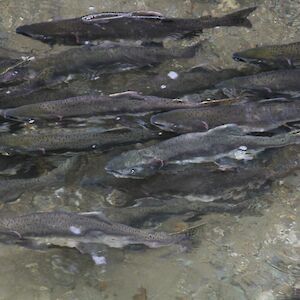
- The Yukon, Taku, Stikine, and Alsek Rivers support Pacific salmon runs that sustain river otters, bald eagles, and humans, including some of the 14 First Nations whose Traditional Territories lie in this approximately 419,000 km2 region.
Our solutions
Monitoring freshwater fish
- We're conducting field research on Lake Sturgeon in Ontario and working closely with the Moose Cree First Nation on stewardship efforts for this ancient fish.
- We studied how changing environmental conditions affect reproduction in Yukon's Chinook salmon.
Science for good planning
- We compiled information on climate, elevation, and hydrology across the Arctic drainage basin and examined almost a century of scientific fish sampling records to predict which northern Ontario watersheds are likely the most important for freshwater fish, and thus most in need of protection.

The water we share
Why we're focused on the far north in Ontario, and what we are doing to conserve its incredible freshwater ecosystems.
Projects

Learning from Lake Sturgeon
Big fish need healthy rivers.
Media coverage
Ottawa’s $1-Billion Ring of Fire Pledge Advances Ontario’s Mining Plans, but Major Decisions Remain
WCS Canada questioned whether enough evidence had been provided about roads on compressed peat, calling for stronger information on the effects on water movement, vegetation and peatland ecosystems, as well as more integrated assessment of development across the region.
2026-10-26 | The Weekly Voice
National Conservation Awards Shine a Spotlight on Collaborative Efforts to Connect Canadians to Nature and Save Species on the Brink of Extinction
The Learning from Lake Sturgeon Youth Advisory Group win the inaugural Youth for Wildlife Conservation Award at the True North Wildlife Conservation Awards, an initiative to celebrate Canadian environmental innovation, leadership and impact.
2026-10-21 | Business Insider
Carney’s Push to Fund Industry Imperils Canada’s Nature Promises
WCS Canada President Justina Ray says that federal government’s funds and perks are subsidizing the destruction of nature, contravening Canada’s global biodiversity commitments.
2026-09-28 | The Tyee


Stories and op-eds

Canada cannot afford to miss the biodiversity train
KBA Canada Technical Coordinator Chloé Debyser outlines the risks posed to 18 Key Biodiversity Areas by the proposed Alto high speed rail line, and how Canada's recently announced Nature Strategy already has the tools for common sense solutionsChloé Debyser

Demystifying the Mitigation Hierarchy
A practical guide to one of the most important, yet misunderstood, frameworks in conservation and development decision making.Justina Ray, Ciara Raudsepp-Hearne

Women in conservation: Finding balance, voice, and impact
To mark International Women's Day, we sat down with Chrystal Mantyka-Pringle, Co-Director of our Northern Boreal Mountains program to talk about her career to date and what's kept her in the sector.Chrystal Mantyka-Pringle
Press releases